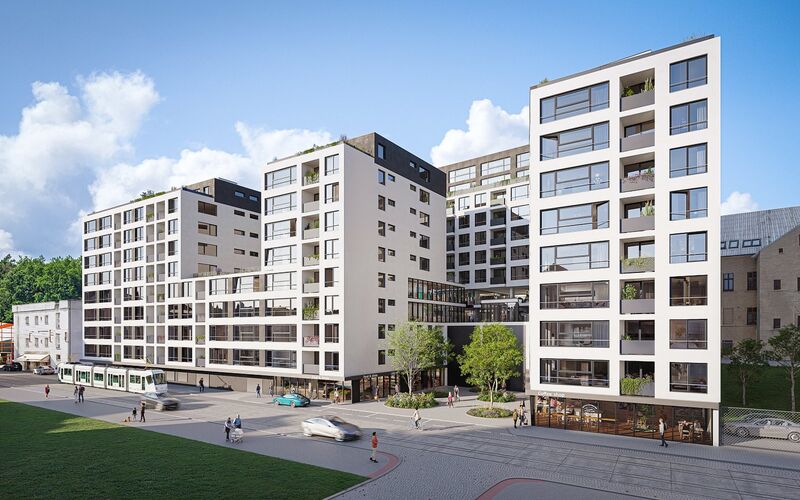
We used a model Prague flat to compare the cost of renting with a mortgage repayment. Here you'll find the upfront costs, the point at which buying pays off, and what to do if you leave the Czech Republic after a few years.
For a foreigner working in the Czech Republic, buying a flat in Prague usually pays off only after five to ten years, with mortgage rates currently around 5.8%. The exact timeframe depends mainly on how quickly flat prices and rents rise. If you plan to stay in the Czech Republic for less than five years, renting tends to make more financial sense. The exception is if you want to let the flat out long term after you leave, and you can handle the currency risk and any shortfall you may have to cover yourself.
Rent vs mortgage repayment in Prague in 2026
Let us take a model 2+kk flat of 60 m² in a good Prague neighbourhood. According to the Nemovitomat portal, the median asking price for flats in Prague in September 2026 was around CZK 170,000 per m². Actual sale prices tend to be lower, so we are using a price of CZK 9.6 million, or CZK 160,000 per m². The median asking rent in September 2026 was about CZK 478 per m² per month, so the same flat would let for roughly CZK 28,700 a month, excluding utilities.
According to the Swiss Life Hypoindex, the average offered mortgage rate rose to 5.79% in October 2026. This was its seventh consecutive monthly rise since the low point in March. If you borrow 80% of the price, i.e. CZK 7.68 million over 30 years, the monthly repayment comes to approximately CZK 45,000. The repayment itself is not what matters most, though. At the start, about CZK 37,000 of it goes on interest and only around CZK 8,000 on the principal, which is effectively money you are saving for yourself. In the first few years, the interest alone is higher than the rent for a comparable flat.
Upfront costs of buying: deposit, fees and renovation
The Czech National Bank keeps the upper LTV limit (the ratio of the loan to the property's value) at 80% for mortgages on owner-occupied homes. Applicants under 36 can borrow up to 90%. Since 1 April 2026, stricter recommendations have applied to investment mortgages: a maximum LTV of 70% and total debt of no more than seven times net annual income. A loan counts as an investment loan if it is for a third or subsequent residential property, or for a property intended for letting. Banks also often set their own conditions for foreign applicants, for example regarding the type of residence permit or the length of the employment contract.
- Deposit: CZK 1.92 million for the model flat at 80% LTV, or CZK 960,000 at 90% LTV.
- Real estate transfer tax (daň z nabytí nemovitých věcí) has not been payable since 2020, when it was abolished by Act No. 386/2020 Coll.
- The administrative fee for an application for registration in the Land Register (katastr nemovitostí) is CZK 2,000; it may be lower if the conditions for electronic filing are met.
- Other items: the bank's property valuation, a lawyer and escrow for the purchase price, and possibly translations and certified signatures.
- Renovation, furnishing and a reserve for unexpected repairs, which with older flats often make up the largest share of upfront costs.
In the calculation below, we allow CZK 300,000 for upfront costs and alterations to the flat, and the same amount for the costs of a future sale. This is a model assumption, not a market average.
The break-even point: after how many years buying pays off
On the owner's side are the annual non-recoverable costs: interest (about CZK 440,000 in the first year) and the lost return on your own money. On CZK 2.2 million at a model return of 3% a year, that comes to roughly CZK 66,000. Add contributions to the building's repair fund, insurance and property tax, estimated at CZK 60,000 a year. That makes a total of about CZK 566,000. A tenant pays approximately CZK 344,000 for the same year. The difference of around CZK 220,000 a year has to be made up for the owner by the rise in the flat's value.
If flat prices rise by 3% a year and rents rise at the same rate, the simplified model shows the owner catching up with the tenant after roughly five years, including both purchase and sale costs. If rents stagnate, the break-even point moves out to nine or ten years. With flat prices and rents both rising by 2% a year, the break-even point comes at around nine years. If prices stagnate, buying does not pay off within a normal timeframe, unless rates fall significantly and you refinance your mortgage more cheaply. The good news is that the balance improves over time: the interest share of the repayment falls and rents usually rise. So always run the calculation with your own figures and several scenarios.
What if you move away after three years?
After three years of ownership, the model shows the owner roughly CZK 300,000 worse off than the tenant, even with favourable price growth. Over such a short period, the purchase and sale costs cannot be spread out. Income tax also plays a role. The gain from selling a flat is exempt if it was your place of residence for at least two years immediately before the sale. For flats acquired from 2021 onwards, there is also an exemption after ten years of ownership. So if you sell straight away when you leave, you will usually meet the two-year test. If you let the flat out for several years first and only sell afterwards, you will probably lose the exemption and the gain will be taxed. Check your specific situation with a tax adviser before selling.
Letting out your own flat after leaving the Czech Republic
For many foreigners, keeping the flat and letting it out is a sensible option, but it should not rest on inflated expectations. In the model example, rent of around CZK 28,700 would cover neither the CZK 45,000 repayment nor the management costs, so you would have to make up the difference from your own pocket every month. Before you let the flat out, inform your bank. A mortgage for an owner-occupied home has different terms from a loan on an investment property, and your contract may prohibit letting without the bank's consent.
Rental income from a flat in the Czech Republic is taxed in the Czech Republic, even if you are no longer a Czech tax resident. You must file a tax return, most often using flat-rate expenses of 30% (up to CZK 600,000 a year) and a tax rate of 15%, or 23% on higher incomes. At the basic rate, the effective tax therefore comes to roughly 10.5% of the rent. A non-resident from outside the EU and EEA can claim only the basic taxpayer allowance. Managing from abroad, you will also need reliable property management and a power of attorney so that matters can be dealt with locally.
Currency risk and income in another currency
If you are paid in euros, dollars or pounds but repay your mortgage in koruna, you carry currency risk. If the koruna strengthens, the repayment becomes more expensive in your currency. Once you leave the Czech Republic, the risk is reversed: you receive rent in koruna but pay your living costs in another currency. For income in a foreign currency, banks usually apply a safety margin and may lend less. Sensible protection means keeping a reserve to cover several repayments, not fixing the rate for too short a period, and buying only if your budget still works at a less favourable exchange rate.
Questions to ask before you decide
- Will you stay in Prague for at least five years? If not, renting usually makes more financial sense.
- Do you have your own funds of 20% of the price, or 10% if you are under 36, plus a reserve for upfront costs and repairs?
- Do you, as a foreigner, meet the bank's mortgage conditions, and will the bank take your foreign-currency income into account?
- Does your budget still work with a rate one percentage point higher and an unfavourable exchange rate?
- Do you have a plan for leaving: a sale that meets the two-year test, or letting with the bank's consent and remote management?
- Have you calculated the break-even point for several price-growth scenarios, not just the most optimistic one?
Frequently asked questions
Can a foreigner buy a flat and get a mortgage in the Czech Republic? A private individual from abroad can buy a flat without any special permit. However, each bank assesses mortgages according to its own rules, particularly the type of residence permit, the length and stability of your income, and the currency in which you are paid.
Is transfer tax payable when buying a flat in Prague? No. Real estate transfer tax was abolished in 2020. You pay only the administrative fee for registration in the Land Register, plus the costs of the valuation, legal services and escrow for the purchase price.
Do I have to pay tax on rent from my Prague flat if I already live abroad? Yes. Income from letting property in the Czech Republic is taxed in the Czech Republic, and you file a Czech tax return for it. How this income affects your taxes in your new country of residence depends on the relevant double taxation treaty. So check your specific situation with a tax adviser, and the legal aspects of buying and letting with a lawyer.
DALILE LIVING can help you choose a flat, check that the price is fair, arrange any renovation, and later let or sell the property. We will also be happy to go through your own calculation with you to work out whether renting or buying is better for you in Prague.
Sources
- Swiss Life Hypoindex – vývoj průměrné sazby hypoték (říjen 2026: 5,79 %)
- ČNB doporučuje přísnější limity pro investiční hypotéky (LTV 80/90/70 %, DTI 7)
- Nemovitomat – nabídkové ceny bytů a nájmů v Praze (září 2026)
- Zákon č. 386/2020 Sb., kterým se zrušuje daň z nabytí nemovitých věcí
- Portál veřejné správy – Návrh na vklad do katastru nemovitostí
- Finanční správa – Pronajímatel (daň z příjmů z nájmu)
- Finanční správa – Daňový nerezident ČR
- DAUC – Osvobození příjmů při prodeji nemovitosti